Planning Your Wedding Day Photography Timeline
One of the biggest things to consider when planning your wedding day is the timeline. Between getting ready, the ceremony, family photographs, and the reception, there's quite a lot to fit into one day. And while photography is an important part of it all, you probably don't want to spend your entire wedding day taking pictures. The good news is, you don't have to! With a little planning, you can make sure there's enough time to capture all those important photographs without sacrificing the experience of your wedding day. After all, you've probably spent months, maybe even years, planning this celebration, and you deserve to actually enjoy it.
Of course, every wedding is different. Some couples want plenty of portraits, while others would rather spend most of their time celebrating with friends and family. Some weddings are large, traditional celebrations with full wedding parties, while others are small, intimate gatherings with only a handful of guests. There's no right or wrong way to go about it, but knowing how much time to allow for different types of photographs can make planning your day a whole lot easier. So, let's break down a typical wedding day and talk about how much time you might want to set aside for photography.
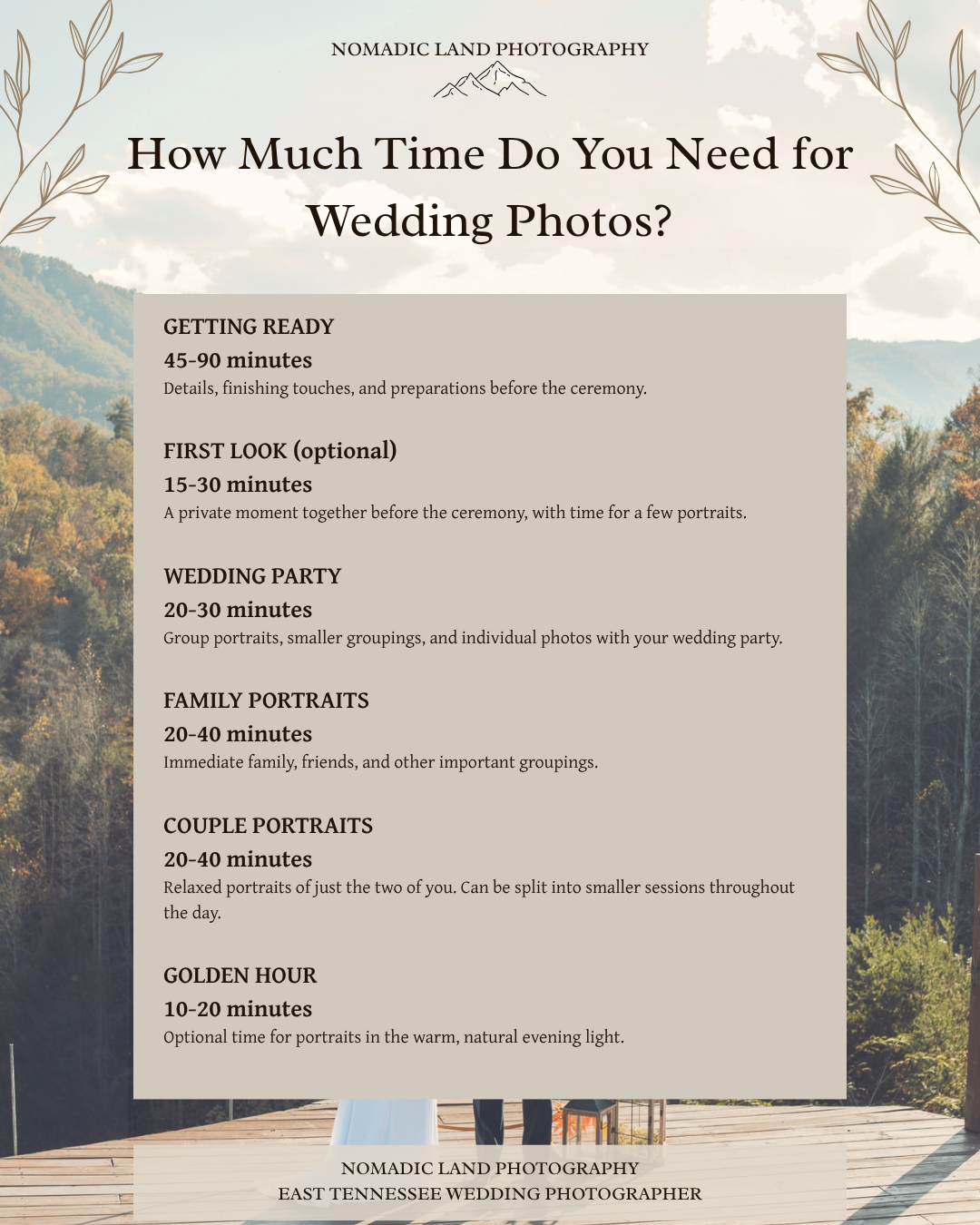
Be sure to read through to the end for a free, downloadable wedding photography timeline guide you can save and reference while planning your big day!
Getting Ready | 45–90 Minutes
Some of my favorite moments to photograph happen before the ceremony even begins. There's a certain excitement in the hours leading up to a wedding, with everyone getting dressed, putting on the finishing touches, laughing, running around, and occasionally trying to remember where they left something important. It's also a wonderful opportunity to capture some of the smaller details you've spent time putting together, such as your rings, wedding attire, shoes, invitations, jewelry, and anything else that might hold a little sentimental value. These details are often overlooked in the excitement of the day, but they can be a beautiful part of telling the whole story.
I typically recommend having your photographer arrive toward the end of the getting-ready process. You don't necessarily need hours of photographs of everyone having their hair and makeup done, and in most cases, capturing the finishing touches, getting dressed, and those last moments before the ceremony is plenty. One thing that can make this part of the day much easier is gathering any important details you'd like photographed in one place beforehand. That way, your photographer isn't spending valuable time searching for shoes, rings, or other items while everyone is getting ready. If you're getting ready in separate locations, you'll also want to consider whether your photographer will have enough time to visit both spaces.


First Looks | 15–30 Minutes
First looks have become a popular addition to wedding timelines, and I can certainly understand why. It's an opportunity for the two of you to see each other before the ceremony, often in a more private setting without everyone watching. Some couples choose to exchange letters, read private vows, or simply spend a few quiet minutes together before the festivities begin. Others prefer the more traditional experience of waiting until the ceremony to see each other for the first time, which can be just as meaningful. Those that prefer to save the First Look for the ceremony, consider having a private First Touch, when the couple meets at a corner or a door to hold hands and exchange little words of encouragement before the ceremony without spoiling the visual reveal. It's entirely a personal preference, and no option is necessarily better than the other.
If you're considering a first look, I'd recommend setting aside around 15–30 minutes. This gives everyone enough time to get into place, allows your photographer to capture the moment, and gives you a little privacy afterward without immediately rushing into the next activity. One major benefit of having a first look is that it opens up the opportunity to take some of your couple and wedding party portraits before the ceremony. This can be especially helpful if you'd rather spend cocktail hour with your guests or if you're planning a wedding later in the evening when daylight might be limited.


Wedding Party Portraits | 20–30 Minutes
If you're having a wedding party, you'll probably want a few photographs with everyone together. This might include the entire group, smaller groups, and individual photographs with the people standing beside you on your wedding day. For most weddings, around 20–30 minutes is a good starting point, although larger wedding parties may need a little more time. The biggest thing here is simply making sure everyone is ready and in the same place. It's amazing how quickly a short photography session can turn into a much longer one when half the group has wandered off or someone is still getting dressed!
And don't feel like every photograph has to be perfectly posed. While I always make sure to capture those traditional group photographs, I also love photographing the interactions between everyone. The laughter, the teasing, and the personalities of the people you've chosen to celebrate with are just as much a part of your wedding story as the formal photographs. Having a little extra time to work with gives us the opportunity to capture both without feeling rushed. In my experience, I find it best to take wedding party photographs before the ceremony, keeping the two sides separate if you're not planning a first look. This gets one more thing checked off the list before the busyness that follows the ceremony, when everyone is excited to congratulate the newlyweds and get a few photographs with the couple. It also frees up a little more time afterward for family portraits, couple portraits, and simply enjoying the celebration.
Family Portraits | 20–40 Minutes
Family photographs are one of those things that can seem pretty simple until you're actually trying to gather twenty different people into one place. Between finding family members, organizing different groupings, and making sure nobody important gets left out, this portion of the day can easily take longer than expected. That's why I always recommend making a family portrait list before the wedding. Think about the combinations that are most important to you, such as parents, grandparents, siblings, immediate family, and any other groupings you know you'll want to have photographed. Having that list prepared allows your photographer to work through everything efficiently rather than trying to figure it all out on the spot.
For smaller families, 20 minutes might be plenty, while larger families or longer portrait lists may need closer to 30–40 minutes. I also highly recommend having someone who knows your family help gather everyone together. Your photographer probably doesn't know which Uncle John is Uncle John, but someone in your family certainly does! Keeping the formal portrait list fairly simple can also save quite a bit of time. That doesn't mean you can't have photographs with extended family and friends throughout the day, but it does mean you won't spend an hour standing in one place trying to capture every possible combination. In my opinion, it's better to prioritize the photographs that are most meaningful to you and leave some room for those more natural interactions later on.
These photographs usually take place directly after the ceremony, when everyone is eager to congratulate the newlyweds and offer their best wishes. Some couples also plan to take their couple portraits during this time, which can make things a little hectic with everyone gathering for photographs and trying to spend a moment with the newly married couple.
Couple Portraits | 20–45 Minutes
Now, this is probably the part most couples think about when they imagine their wedding photographs. It's an opportunity to step away together and capture some beautiful photographs of just the two of you, whether that's somewhere around your venue, in a nearby field, or against a mountain backdrop. For most weddings, I recommend setting aside around 20–45 minutes for couple portraits. The exact amount really depends on what you're looking for, how many locations you'd like to use, and how much time you're comfortable spending away from the celebration. If you're hoping for a handful of natural portraits, we can often accomplish that in a fairly short amount of time. If you'd like more variety, multiple locations, or something a little more creative, you'll want to allow some additional time.
One thing I really like to recommend is splitting couple portraits into smaller sessions throughout the day. For example, we might spend 15–20 minutes together after the ceremony, then step outside for another 10–15 minutes later in the evening when the lighting is especially beautiful. This gives you a nice variety of photographs without pulling you away from your celebration for one long session. And remember, you don't have to know how to pose! That's part of my job. I prefer to keep things fairly natural, offering a little direction when it's needed, but otherwise allowing couples to interact with each other without feeling like they're constantly performing for the camera. Sometimes the best photographs happen in those moments between poses, when you're simply enjoying being together.
Golden Hour Portraits | 10–20 Minutes
If you're planning an outdoor wedding, especially here in the mountains of East Tennessee, I'd highly recommend leaving a little room in your timeline for golden hour photographs. Golden hour is the period shortly before sunset when the sunlight becomes softer and warmer, often creating some really beautiful lighting for portraits. Depending on your venue, the weather, and the time of year, this can be a wonderful opportunity to sneak away for a few more photographs without taking much time away from your reception. You certainly don't need to spend an entire hour doing them. Sometimes stepping outside for just 10–15 minutes is enough to capture something beautiful.
One thing worth remembering is that sunset times don't always tell the whole story, especially in the mountains. If your venue sits down in a valley or is surrounded by tall trees, you might lose direct sunlight well before the actual sunset. On the other hand, venues with open fields or elevated views may have beautiful light much later in the evening. It's always worth discussing the location and timing with your photographer beforehand, particularly if sunset portraits are something you're really looking forward to.



Reception Photography | Let the Day Happen
Once the reception begins, things tend to become a little less structured from a photography standpoint. Of course, there are usually a few planned moments, such as grand entrances, first dances, speeches, cake cutting, and any special traditions you might have. These are all things you'll want your photographer to know about ahead of time so they can be prepared and in the right place when everything happens. Depending on how your reception is organized, these events might be spread throughout the evening or grouped together earlier in the celebration.
Outside of those planned moments, I personally prefer to let the day happen. Some of my favorite reception photographs are the ones nobody planned: someone laughing during a conversation, grandparents dancing, children running around, or a quiet moment between two people in the middle of all the excitement. These are the things that really tell the story of your wedding, and they're often the photographs that bring back the strongest memories later on. If you've booked a limited number of photography hours, it's worth thinking about which reception events are most important to have photographed. Sometimes moving your cake cutting, speeches, or first dances a little earlier can help make sure those moments are included without needing additional coverage.
What Does a Typical Wedding Photography Timeline Look Like?
Let's say you're planning a wedding with a 4:00 PM ceremony and eight hours of photography coverage. Here's one example of how that day might look:
12:00 PM Photographer arrives, details and getting ready
1:30 PM First look and couple portraits
2:00 PM Wedding party portraits
2:30 PM Final preparations and ceremony details
4:00 PM Ceremony
4:30 PM Family portraits
5:00 PM Additional couple portraits and cocktail hour
5:30 PM Reception begins
7:00 PM Sunset portraits, if timing allows (during summer/early fall hours)
8:00 PM Photography coverage ends
This is just one example of how a wedding day might be organized, and your timeline will depend on several things, including the size of your wedding, ceremony length, venue layout, travel time, and the season. A wedding without a first look might move most of the portraits to after the ceremony, while a smaller wedding might need considerably less time for family photographs. If you're planning a larger celebration or have several locations you'd like to use, you'll probably want to leave yourself a little more breathing room. It's also important to remember that not every minute of photography coverage needs to be scheduled. Much of the day can be photographed as it naturally unfolds, with only certain portions requiring dedicated time for portraits.
A Few Things That Can Make Your Wedding Day Run a Little Smoother
If there's one thing I would encourage couples to do, it's to leave themselves a little extra time wherever possible. Weddings rarely run exactly to the minute, and that's perfectly fine. Someone might be running late, hair and makeup might take a little longer than expected, or you might simply want a few more minutes with your family before the ceremony. Having some flexibility built into your schedule makes those little delays much less stressful and prevents one small change from affecting the entire day. I'd also recommend keeping travel time in mind if you're getting ready, having your ceremony, and hosting your reception at different locations. Even a short drive can take up more time than you expect once everyone is gathered and ready to leave.
And finally, communicate with your photographer! Let them know which photographs are especially important to you, whether there are family circumstances to consider, or if there's something unique you've planned for the day. Maybe there's a special heirloom you'd like photographed, a family member you particularly want to have portraits with, or a private moment you've planned that you don't want interrupted. These are all things worth mentioning beforehand. The more your photographer knows about your plans and priorities, the easier it is to build a timeline that works for you rather than trying to fit your wedding into a predetermined schedule.
Your Wedding Day Is More Than a Photoshoot
At the end of the day, your wedding photographs should tell the story of your wedding, not become the entire story themselves. Of course, I want you to have beautiful portraits to hang on your walls. I want you to have those photographs with your parents, grandparents, and the people you love. Those images are important, and they're worth setting aside time for. But I also want you to remember what your wedding day actually felt like. I want you to enjoy your dinner, laugh with your friends, dance with your family, and have the opportunity to experience all the little moments that make the day yours. After all, those are the moments that make your photographs meaningful in the first place.
That's why I believe a good photography timeline should provide just enough structure to capture the important photographs while leaving plenty of room for everything else. You don't need to plan every minute of your day around the camera, and you certainly don't need to feel like you're missing your own celebration just to have beautiful wedding photographs. A little preparation, some flexibility, and a photographer who understands your priorities can make all the difference. Because years from now, I hope your photographs remind you of more than what your wedding looked like. I hope they bring you right back to what it felt like to be there.
Less posing. More living.
Nomadic Land Photography specializes in documentary-style wedding photography throughout East Tennessee and the surrounding Appalachian region. If you're planning your wedding and looking for a photographer who values natural moments, genuine connections, and a relaxed approach to your day, I'd love to hear about your plans.
Save this image as a quick reference guide!